
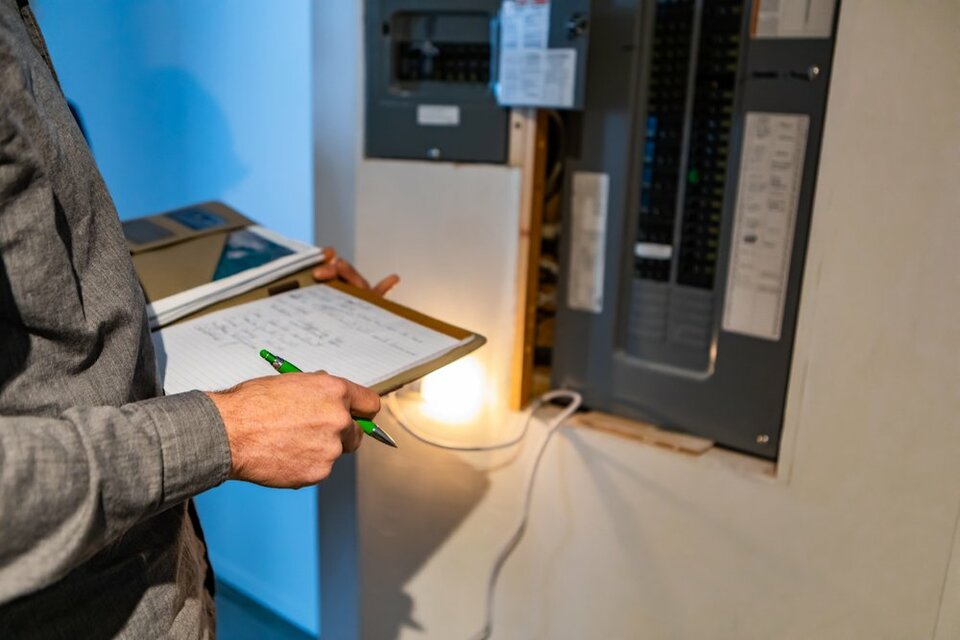
An Electrical Installation Condition Report (EICR) is an invaluable roadmap to compliance for your business. Regular testing ensures your installation meets safety standards, like BS7671, and reports on any faults that compromise your fire safety.
If you’re struggling to understand the EICR, think of it as an MOT for your building. Without it, you could put your team's lives at risk.
First, let’s look more at the EICR meaning. An EICR is a critical electrical safety test that must be carried out by a qualified electrician. It covers wiring and cables, earthing and bonding, and consumer units, ensuring your installation meets the requirements for continued use.
Multiple faults and fire risks can lurk out of sight in your building. A thorough EICR report gives you peace of mind that your electrical infrastructure is fit for purpose.
EICR testing frequency depends on several factors, including the type of electrical equipment, your reliance on it, and the age and type of the building. As a result, different businesses and premises have different testing recommendations:
Carrying out fixed wire testing and obtaining an EICR certificate isn’t mandatory for commercial property. However, without one, you’ll be in breach of regulations, including:
Read more about EICR Testing – everything you need to know.
Faulty installations and outdated electrical systems are the root cause of most common EICR failures. Other failures include:
Learn more about common compliance pitfalls and how to avoid them.
At first glance, an EICR report can seem overwhelming. What’s more, misinterpretation of your report could lead to fines, invalidated insurance and public liability claims.
There are several key sections of your EICR report. These include the report's purpose and the extent and limitations of the inspection, including what was and wasn’t tested (e.g., wiring under floorboards).
EICR testing aims to ensure the safety of building users and to identify any non-compliant issues that may pose a fire risk. The report should identify any dangerous damage or defects, and confirm whether the installation is safe for continuous use. Finally, the schedule of test results lists every circuit tested and the protective device covering it.
The key to understanding your EICR report is the codes used for electrical faults. These are listed in the Observations section of your report.
C1 (Danger present): This code is used when there’s an immediate danger, such as exposed live wires. Remedial action is required immediately to prevent the threat of injury.
C2 (Potentially dangerous): This code indicates faults that require urgent action where the installation could become hazardous. For instance, a lack of RCDs is a C2 fault.
C3 (Improvement recommended): A C3 code is issued where the installation is not dangerous but requires upgrading for safety or compliance. For instance, a consumer unit is made of plastic, not metal.
F1: (Further investigation): The inspector found an issue that needed further checks or was unable to access an area for testing.
Please note: C1, C2, and F1 codes will all result in an unsatisfactory report.
If your EICR report is unsatisfactory, you must take the following steps to ensure compliance and safety.
An EICR certificate is about more than compliance. It ensures peace of mind for your business. At phs Compliance, we’re the nationwide leaders in EICR Inspections and Certification (Fixed Wire Testing), providing consistently high-quality services from our team of EICR specialists. Contact us today to book your EICR report.

phs Compliance has delivered multiple compliance services to leading UK hotel groups for many years. We’ve delivered electrical installation inspection services, portable and fixed appliance
Our client’s transport division helps ensure UK railways, motorways, roads and airports run safely and smoothly supported by engineering design, construction, installation and maintenance services.
Through our Tier 1 facilities management client, phs Compliance self-delivered comprehensive project services for replacement emergency lighting across a large fully operational RAF base. As a high
phs Compliance began working with our 'Big Four' food and grocery retail customer in 2009, delivering fixed wire and portable appliance inspection and testing services across one hundred per cent of
This site uses cookies that enable us to make improvements, provide relevant content, and for analytics purposes. For more details, see our Cookie Policy. By clicking Accept, you consent to our use of cookies.
