
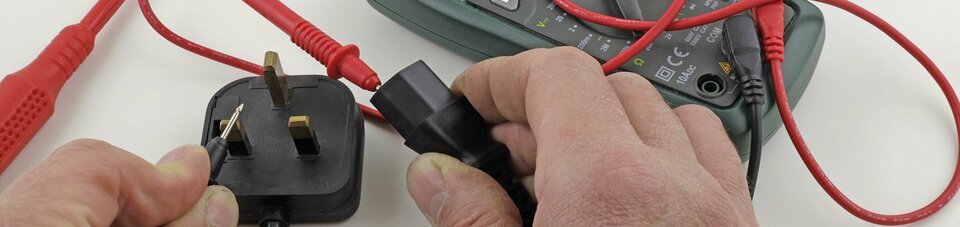
Keep your equipment safe and compliant with nationwide portable appliance testing (PAT) from accredited engineers. Book a visit that fits around your business, with minimal disruption and digital certificates issued on completion.

We aim to complete PAT testing with minimal disruption, and can work within times to suit you.

We carry out over 10 million PAT tests every year.

Founded in 1991, you can trust our expertise and efficiency.

We cover the whole of the UK. Our local teams can get to you quickly and efficiently.
Our accredited testers and engineers cover every region of the UK, from single-site offices to multi-site facilities. Every visit is scheduled around your operating hours, so your team keeps working while testing takes place.
We carry out 10 million PAT tests every year, and with over 30 years' experience we regard ourselves as one of the country's most trusted providers of commercial PAT and electrical equipment testing.
PAT testing is the inspection and testing of portable and electrical equipment to ensure it is safe to use and meets workplace safety requirements. EET (Electrical Equipment Testing) is the newer broader term that covers all in-service inspection and testing of electrical equipment in the workplace, of which PAT (Portable Appliance Testing) is the most widely known component.
Under the Electricity at Work Regulations 1989, employers are responsible for ensuring all electrical equipment is maintained in a safe condition. PAT and EET provides the documented evidence that this duty is being met.
phs Compliance is one of the few national providers accredited to carry out both PAT and full EET programmes, giving you a single point of contact for all electrical equipment compliance across your estate.
Yes, under the Health and Safety at Work Act 1974 and the Electricity at Work Regulations 1989, employers must ensure portable electrical equipment is safe and properly maintained.
The IET Code of Practice requires regular inspection and testing, with records kept for the equipment’s working life. Failure to comply can lead to serious safety risks, penalties and legal action. Our accredited team provide you with the service and documentation you need to stay safe and compliant.

PAT and EET testing can include:

IT equipment: laptops, desktop computers, monitors, printers, scanners
Kitchen appliances: microwaves, toasters, kettles, fridges
Office equipment: photocopiers, shredders, fans, desk lamps
Power tools: drills, saws, grinders
Cleaning equipment: vacuum cleaners, floor polishers, steam cleaners
Power leads: extension leads, multi-way adaptors and surge protectors
Fixed appliances: ovens, air conditioning units, water heaters
If you are unsure whether a specific item requires testing, our team can advise — or carry out a full site survey to identify every item in scope.
Our engineer will visit on the agreed date, tests each item of portable electrical equipment against the relevant safety standard, labels tested equipment, and flags anything that needs repair or replacement. You’ll receive a digital certificate and full asset register on completion. Here’s what to expect on the day:
1
We agree a testing programme with you in advance, working around your business hours where needed.
2
Each appliance is checked for signs of damage, incorrect wiring or wear.
3
Using calibrated equipment, we check earth continuity, insulation resistance and (where applicable) load testing.
4
Each appliance is checked for signs of damage, incorrect wiring or wear.
5
You receive a full digital report listing every item tested, its result, and any remedial actions required. Records are retained for the lifetime of the equipment.
Failed items are quarantined and clearly marked. Where repair or replacement is needed, our team can advise on next steps.
Testing time depends on the number and type of appliances on site. A typical office environment with 100–200 items can usually be completed within a day. For larger or more complex sites we schedule testing in phases to minimise disruption. Our team will agree a detailed programme with you in advance.
On completion you receive a full digital certificate listing every item tested, its result (pass/fail), the date of test and the recommended retest date. Failed items are clearly identified with recommended remedial actions. All records are stored electronically for the lifetime of the equipment, giving you an auditable compliance trail for inspectors or insurers.
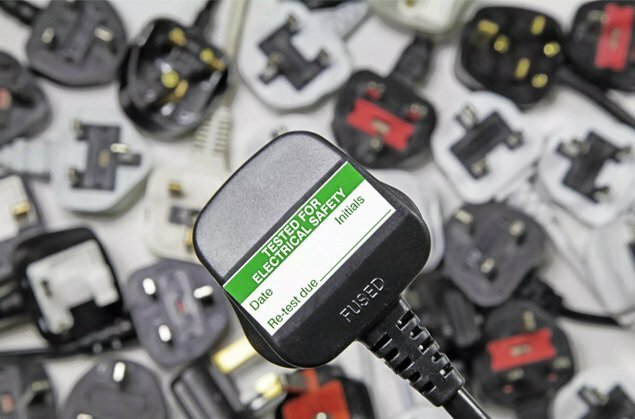
When a PAT test is carried out, documentation and stickers will advise you on how long each appliance has a valid PAT test for. PAT test stickers show when an item was tested and when it should next be inspected, helping businesses keep electrical equipment safe and compliant.
Yes, the Electricity at Work Regulations 1989 places duties on employers to ensure that all electrical equipment and systems are safe and do not pose dangers to employees or visitors.
PAT Testing and Electrical Equipment Testing (EET) are effectively the same service. The term EET is a newer term that’s now preferred within the industry, because it covers a broader range of electrical equipment, not just portable appliances. The testing methods, safety checks and compliance objectives remain exactly the same.
The frequency of testing depends on a few different factors, a risk assessment from the duty holder of the organisation, or delegation of authority, the risk assessment will look at the type of equipment, where it is used, and how often it is used.
For example, a hotel lamp will need less frequent testing compared to a power tool on a building site. phs Compliance can provide tailored advice to your business around testing frequency.
There’s no set cost for PAT and EET testing as every customer’s price is different, based on amount and type of appliances. Our quotes are free and efficient, so the best way to get a price is to get in touch for your own quote today.
We work across all sectors including:
No, we cover every part of the UK. With one of the largest teams of Electricians and PAT testers in the industry, our experts are based nationwide meaning we can get to you wherever you are.
With local teams operating across the UK, phs Compliance can reach your sites quickly, wherever they are. We regularly carry out PAT and EET testing for businesses across:
You'll find our engineers working across manufacturing, education, distribution and logistics, warehouses, facilities management and retail, wherever portable electrical equipment needs regular testing to stay compliant.



Bright Horizons, a leading name in the UK childcare sector, operates over 300 nurseries nationwide. Renowned for their commitment to quality childcare, Bright Horizons aimed to enhance their
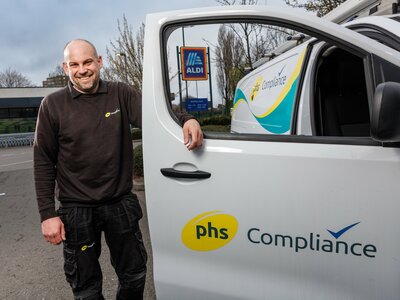
Aldi, a rapidly growing supermarket chain in the UK and Ireland, focuses on sustainability and operational efficiency. They partnered with phs Compliance to reduce energy consumption, improve
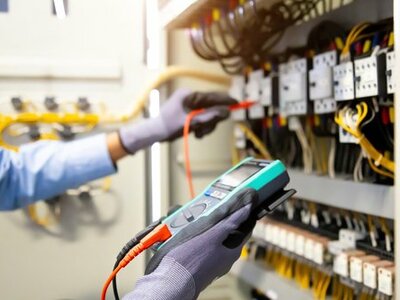
For over a decade, Kwik Fit has relied on phs Compliance to safeguard the electrical integrity of its nationwide network of more than 800 sites. As one of the UK’s leading tyre, MOT and car servicing

Our client, one of the UK’s ‘Big Four’ grocery retailers, needed technical expertise to better understand its building assets and facilities operations with specific reference to its superstores
This site uses cookies that enable us to make improvements, provide relevant content, and for analytics purposes. For more details, see our Cookie Policy. By clicking Accept, you consent to our use of cookies.