
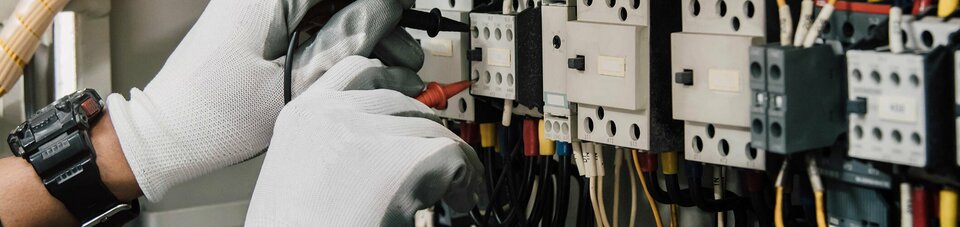
phs Compliance offer a comprehensive Fixed Wire Testing service for
businesses across the whole of the UK. As part of this testing, you will
be provided with an Electrical Installation Condition Report (EICR).

We aim to complete fixed wire testing with minimal disruption and can work at times to suit you.

We carry out over 1 million fixed wire tests every year.

Founded in 1991 you can trust our expertise and efficiency.

We cover the whole of the UK. Our local teams can get to you quickly and efficiently.
phs Compliance provides nationwide EICR (Electrical Installation Condition Reports)and Fixed Wire Testing service for businesses across the UK. Every inspection is carried out by a qualified engineer, fully documented, and backed by UKAS-accredited certification, so your business stays compliant with the Electricity at Work Regulations 1989.
Our qualified engineers complete over 1 million fixed wire tests every year accredited to UKAS (ISO 17020) inspection body standards, which is among the highest levels of accreditation available for electrical testing in the UK. All inspections are scheduled around your operations to minimise disruption, with flexible out of hours work available. Reports are delivered digitally with clear pass or fail outcomes, classification of any defects, and recommended remedial actions which we can undertake after we've carried out the report.
An EICR (Electrical Installation Condition Report) is a formal document, sometimes known as certificate, produced by a qualified inspector following a thorough inspection and testing of a property's fixed electrical installation. It assesses the safety and condition of the wiring, consumer units, distribution boards, sockets, switches and earthing arrangements throughout a building.
The EICR assigns a classification to any observations found:
Only installations with no C1 or C2 classifications receive a satisfactory EICR. phs Compliance issues fully documented EICR reports and certificates stored digitally, with your full inspection history retained for audit purposes.
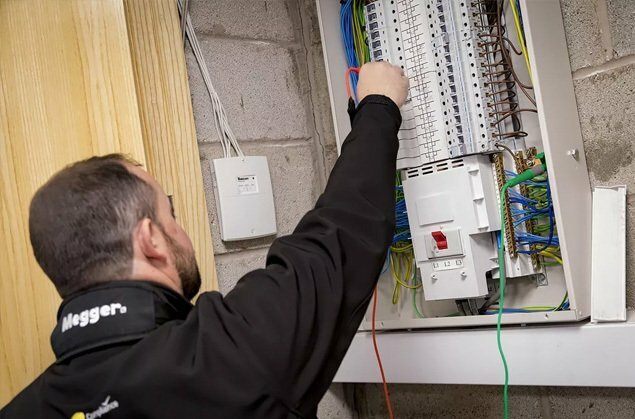
On completion of your inspection, phs Compliance issues a full EICR certificate; a legal document providing an official record of the condition of your electrical installation.
For businesses, the EICR certificate is the primary evidence of compliance with your duty of care under the Electricity at Work Regulations 1989.
To get your certificate, fill out the quote form below, or call our UK-based team.
All EICR certificates are issued digitally and stored securely on your account. For businesses managing multiple sites, consolidated reporting gives you a single view of compliance status across your entire property portfolio.

Full details of the installation inspected and circuits tested
Classification of all observations (C1, C2, C3 or FI)
Overall satisfactory or unsatisfactory result
Recommended remedial actions and target timescales
Next recommended inspection date
Certifying engineer's details and accreditation
For commercial premises, the standard recommended frequency is every 5 years, or on change of occupancy. High-risk or industrial environments may require more frequent inspection. We can advise on the appropriate interval for your premises type and can set up a scheduled programme to keep you continuously compliant.
An EICR will clearly identify whether your electrical installation is satisfactory or unsatisfactory. Where defects are found, the report classifies each issue by severity and specifies the remedial action required.
phs Compliance can carry out all EICR remedial works following your inspection. From minor circuit repairs to full rewiring of affected sections. Having a single supplier handle both the inspection and EICR remedial works eliminates contractor handoffs, ensures continuity of documentation, and speeds up the path to a satisfactory certificate.
Once remedial works are complete, a re-inspection is carried out and a new satisfactory EICR certificate is issued, updating your compliance record.
The Electricity at Work Regulations 1989 require that electrical systems are maintained in a safe condition, but do not specify fixed intervals. These frequencies are industry best practice under BS 7671 (IET Wiring Regulations).
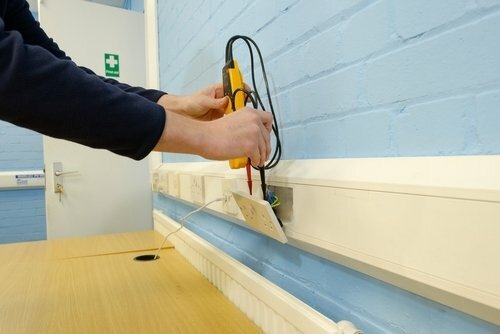
Every 5 years, or on change of occupancy
Every 3 years
(construction sites, swimming pools, petrol stations)
Every 1-3 years
Every 5 years (legally mandated for landlords under the Electrical Safety Standards in the Private Rented Sector (England) Regulations 2020)
We will advise on the correct interval for your specific premises type and can schedule a rolling programme across your portfolio, so inspections never lapse.
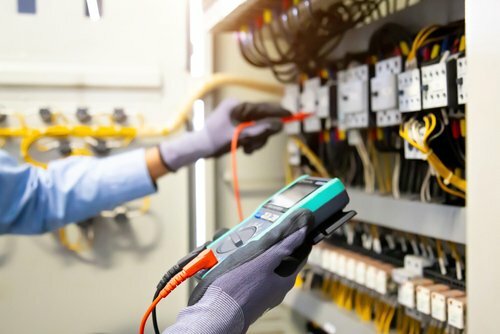
Although an EICR is not specifically mandated by law for every commercial property, businesses have a legal duty to maintain safe electrical installations. An EICR is the industry-standard method and demonstrates compliance with the Electricity at Work Regulations 1989 to meet your obligations as a duty holder.
EICRs are a legal requirement for residential landlords, however. We can help with large private owned portfolios and commercially or council owned portfolios with residential tenants.
Our inspections follow a structured process in line with BS 7671 and IET Guidance Note 3, carried out by qualified engineers working directly for phs Compliance:
1
We review your installation details, agree access arrangements and plan the inspection programme to minimise disruption to your operations.
2
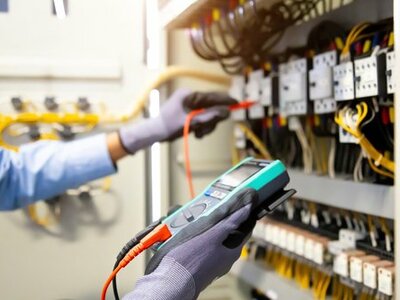
The engineer checks the condition of distribution boards, wiring, sockets, switches, earthing and bonding throughout the premises.
3
With circuits safely isolated, continuity, insulation resistance and polarity tests are performed on each circuit.
4
Earth fault loop impedance and RCD testing are carried out with circuits re-energised.
5
Any defects are classified C1–C3 or FI in line with BS 7671.
6
A full digital report and certificate are issued, with clear findings and any remedial recommendations.
For large or complex premises, inspections are phased to ensure circuits are never isolated longer than necessary. Our engineers carry UKAS-accredited credentials and work to minimise any impact on your day-to-day operations.
An EICR covers all fixed electrical installations within a building including the consumer unit, distribution boards, wiring, sockets, switches, lighting circuits, earthing and bonding. It doesn’t cover portable appliances (which are covered under PAT testing) or the electricity supply up to the meter. The inspection tests the installation against the requirements of BS 7671 (IET Wiring Regulations) and issues a certificate confirming the overall condition.
An EICR (Electrical Installation Condition Report) inspects the fixed wiring and electrical infrastructure of a building like consumer units, circuits, sockets and earthing. PAT testing (Portable Appliance Testing) covers plug-in equipment such as laptops, kettles and power tools.
Most commercial premises require both. phs Compliance provides both EICR and PAT testing services, so you can manage all electrical compliance through a single supplier with one point of contact.
If you own a commercial or residential property or are a facilities manager or company managing a building or portfolio, the chances are you’ll need one. An Electrical Installation Condition Report (EICR) is a legal requirement for all UK workplaces, rental properties or buildings as stipulated in the Electrical work regulations 1989. It is also recommended within BS 7671 as amended (Regulation 135.1) that every electrical installation is subjected to regular EICR.
An EICR assesses the overall safety and condition of an electrical installation, while a thermographic survey uses thermal imaging technology to identify overheating components and hidden faults. Using both methods will prevent and fix issues before they happen keeping your business running without sudden power loss and potential financial loss. phs compliance also offer thermographic surveys if needed, keeping all services under one provider.
A fixed wire test is the inspection that is carried out. An EICR is the certificate and report of the test and inspection. Electrical Installation Condition Report (EICR) and Fixed Wire Testing fundamentally refer to the same process.
While there’s no expiry dates legally mandated for EICRs in commercial properties, we will recommend when the next test and report should be. How long it lasts, and how frequent it’s needed depends on the type of building, risk level and electrical installation.
The Electricity at Work Regulations 1989 places duties on employers to ensure that all electrical equipment and systems are safe and do not pose dangers to employees or visitors.
Cost will vary depending on the size of a building and the complexity of its electrical system. phs Compliance can provide quotes for single or multiple sites. If you have multiple sites, then working with a single supplier can save you money while reducing the amount of time your employees spend on administration.
No, we cover every part of the UK. With one of the largest teams of electricians and fixed wire testers in the industry, our experts are based nationwide meaning we can get to you wherever you are.
We work across all sectors including:
With local teams operating across the UK, phs Compliance can reach your sites quickly, wherever they are. We regularly carry out EICR testing for businesses across:



Bright Horizons, a leading name in the UK childcare sector, operates over 300 nurseries nationwide. Renowned for their commitment to quality childcare, Bright Horizons aimed to enhance their

Aldi, a rapidly growing supermarket chain in the UK and Ireland, focuses on sustainability and operational efficiency. They partnered with phs Compliance to reduce energy consumption, improve
For over a decade, Kwik Fit has relied on phs Compliance to safeguard the electrical integrity of its nationwide network of more than 800 sites. As one of the UK’s leading tyre, MOT and car servicing

Our client, one of the UK’s ‘Big Four’ grocery retailers, needed technical expertise to better understand its building assets and facilities operations with specific reference to its superstores
This site uses cookies that enable us to make improvements, provide relevant content, and for analytics purposes. For more details, see our Cookie Policy. By clicking Accept, you consent to our use of cookies.