
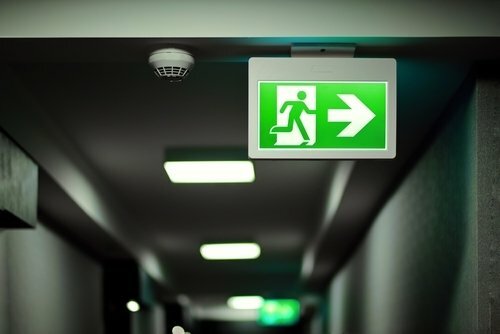
If the main power supply in your building fails for any reason, your emergency lighting is there to provide on-site safety. Emergency light types, including escape route and open-area lighting, are subject to regulations such as BS EN 1838 and BS 5266, as well as the Regulatory Reform (Fire Safety) Order 2005.
In case of an emergency, building users need clear, well-lit exit routes. Understanding emergency light regulations in the UK, along with emergency lighting testing requirements, is the best way to keep your business safe and compliant.
Your building is legally required to have emergency lighting for escape routes, open areas, and high-risk task areas. There are three main emergency light types:
Maintained lights are wired directly to the mains, with a battery backup that kicks in during power failures. As a result, there’s sufficient light for safe evacuation. A maintained system is cheaper and faster to install, but battery life can be limited.
Non-maintained lighting is battery-operated and usually used for exit signs. It only activates during an emergency. These systems are easy to maintain but have higher upfront costs.
Combined lights use two or more lights, with one running on the mains and the other from the emergency lighting power supply. This system allows emergency and exit lights to coexist on one system.
Under BS 5266 in the Building Regulations 2006, emergency lighting is required in buildings where people work or sleep. This includes:
Read more about Emergency Lighting in 2025/2026: A Practical Compliance Guide to BS 5266 for Commercial Buildings.
BS 5266 covers the design, installation, and maintenance of emergency lighting in the UK. It’s a fundamental safety measure that prevents injuries or fatalities in emergencies.
Compliance with BS 2566 is a legal requirement, and includes:
At phs Compliance, our experts offer a complete Lighting Maintenance and Emergency Lighting Testing service for full BS 5266 compliance and peace of mind.
The responsible person is legally accountable for organising and overseeing emergency lighting testing. This designated responsible person will usually be the employer, building owner or landlord, or a facilities manager.
Testing can be conducted by a “competent person”. This is usually a qualified electrician, fire safety professional, or certified engineer who possesses the right training, skills, and knowledge of BS 5266 standards.
Emergency light testing can be performed manually (by physically cutting the power supply) or automatically (via self-testing emergency lighting).
Generally, emergency light test frequency should follow this schedule:
Monthly and annual testing should be recorded and logged.
Your organisation is required to conduct the minimum level of testing outlined in BS EN 50172 / BS 5266-8. Emergency lighting testing has three key goals: safety, compliance and maintenance.
The results of your tests can be recorded on sheets or in a logbook. If you use a third party for testing, you should receive emergency lighting test certificates for your records.
Regular testing keeps your organisation compliant and helps you plan for crucial maintenance.
Key emergency light test details should be recorded as follows:
Emergency lights testing is crucial for your organisation to ensure regulatory compliance and user safety
For complete peace of mind, contactphs Compliance today to access our full range of emergency lighting testing and maintenance services.

Part of a 170-strong nationwide estate, the Yorkshire HMRC site provides taxation services for individuals and corporations along with secure data centre operations. PHS Compliance began delivering
phs Compliance began working with custodial & justice clients of our Tier 1 facilities management provider in 2017 delivering internal & external LED lighting replacement works, electrical power
phs Compliance began working with our Tier 1 facilities management provider delivering electrical safety compliance services across two large hospital sites within the UK’s largest NHS Trust. With

Are you on track? Our customers trust us to maintain and support mechanical and electrical assets across critical infrastructure. We support global financial institutions and brands to maintain safe
This site uses cookies that enable us to make improvements, provide relevant content, and for analytics purposes. For more details, see our Cookie Policy. By clicking Accept, you consent to our use of cookies.
